Actually Need a Full ERP?
When Does a Rental Business Actually Need a Full ERP?
The decision depends entirely on your unique operational complexity, the number of software tools you currently juggle, and your need for integrated reporting.
Key Article Takeaways:
- ERP adoption depends on complexity, not metrics: There is no specific revenue or fleet size threshold; switching to an ERP is driven by operational friction and the need for unified data.
- Tech scaling follows three stages: Businesses move from spreadsheets (Stage 1), to standalone rental tools (Stage 2), to fully integrated ERP platforms (Stage 3).
- Manual bottlenecks are major red flags: Outgrowing your system shows up as heavy spreadsheet reliance, isolated financial data, poor multi-location inventory visibility, and billing delays.
- Unified platforms replace software silos: Platforms like Sycor.Rental (built on Microsoft Dynamics 365) connect rental operations, maintenance, and finance into a single source of truth.
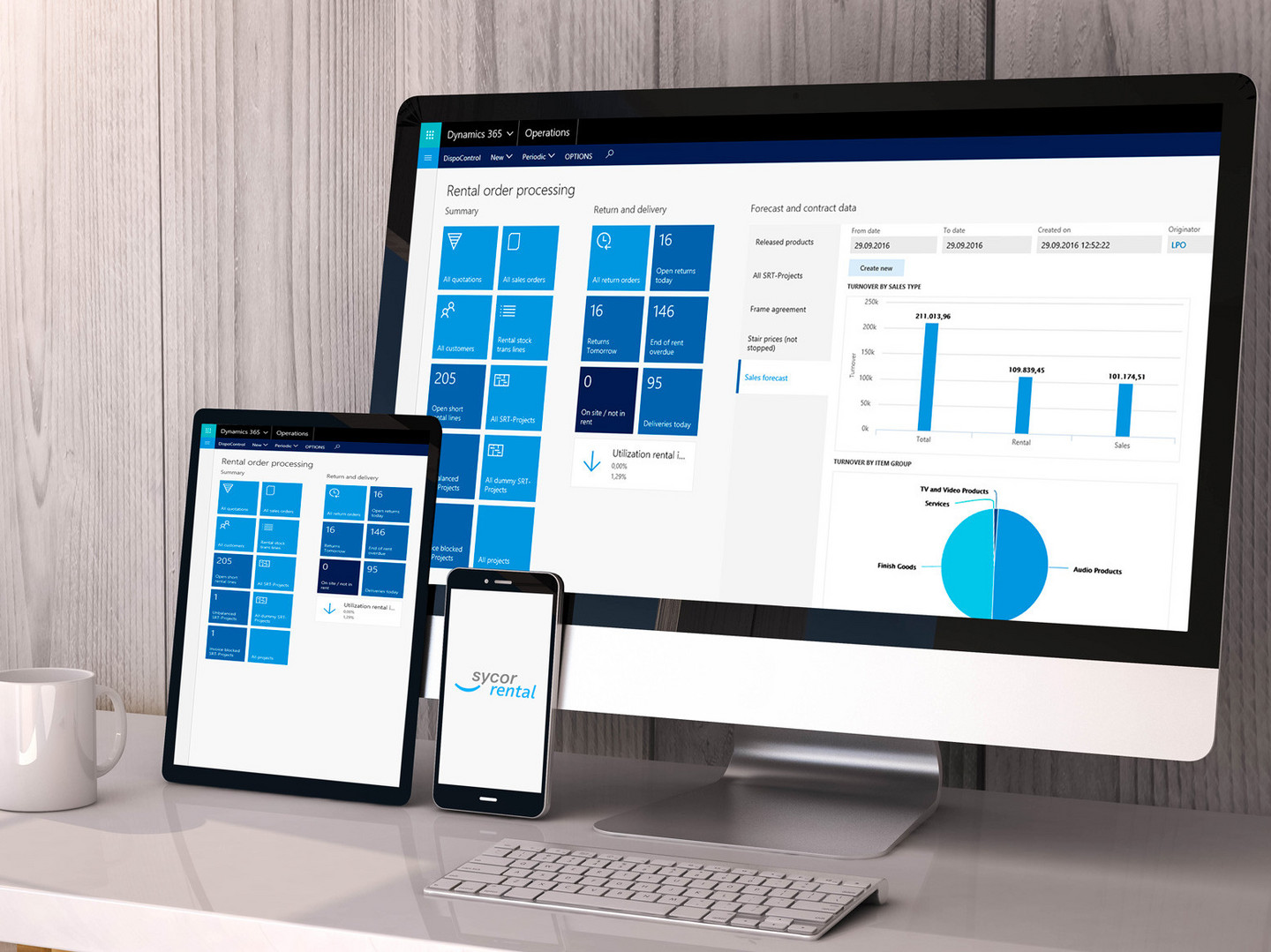
Sycor.Rental leading the way in equipment rental solutions.
Equipment rental is a complex business. You do not just sell a product and move on; your team manages the entire lifecycle of an expensive asset. Dispatchers, mechanics, and the finance department must track the same equipment as it moves from the lot to the job site and into the maintenance bay.
As transaction volumes grow, tracking these moving parts across multiple disconnected systems can overwhelm your staff. Yet, even when a company feels this operational strain daily, leadership can struggle to determine exactly when to switch to ERP platforms instead of relying on legacy tools.
There is no magic revenue figure, fleet size, or employee count that automatically means you need an equipment rental ERP. The decision depends entirely on your unique operational complexity, the number of software tools you currently juggle, and your need for integrated reporting. We see growing rental companies hit a wall when their current technology stack fails to handle multi-location dispatch, custom billing, or real-time asset availability.
If your teams are losing hours every week reconciling spreadsheets or fighting duplicate data entry, it is time to evaluate your infrastructure. Contact Sycor Americas online or call +1 877 487 9267 to discuss whether an integrated platform makes sense for your current growth stage.
The Three Stages of Rental Technology Scaling
Before evaluating ERP for equipment rental packages, you need to understand where your business currently sits on the technology growth curve. Equipment rental businesses typically progress through three distinct software stages as they scale.
Stage 1: Basic Tools and Spreadsheets
Basic tools or spreadsheets are often sufficient for very small or highly localized operations. If a business operates from a single location with a small, uniform fleet, standard spreadsheet software and basic accounting programs can manage the daily workload. At this stage, the business does not yet experience the operational friction that justifies a large software investment.
Stage 2: Standalone Rental Management Software
As a business grows, spreadsheets may not provide all the features needed to keep track of your operations. Standalone rental management software becomes necessary when a company needs dedicated tools to track equipment reservations, dispatch, and basic maintenance. These systems handle the rental workflow well but remain disconnected from the company's core financial and supply chain systems.
Smaller or less complex rental businesses do not need a full ERP if their rental, accounting, inventory, and reporting requirements are handled effectively with these simpler systems.
Stage 3: Integrated Rental ERP
An ERP-based rental platform becomes necessary when operational complexity demands a unified data environment. This connects rental operations to broader business functions, such as finance, supply chain, inventory, maintenance, sales, and reporting, within an integrated platform.
ERP systems consolidate core processes into a unified system, providing real-time data and streamlining business operations.
Operational Signals You Have Outgrown Your Tech Stack
Most ERP friction comes from the mismatch between how work actually happens and how the system expects people to behave. If your rental business experiences several of the following indicators, you likely need a true ERP:
- Your fleet size and asset complexity are steadily increasing. Managing a diverse fleet with different depreciation schedules, attachments, and maintenance cycles requires enterprise-grade tracking.
- You now operate across multiple branches, locations, or legal entities. Operating across state lines or through multiple branches requires centralized inventory visibility and intercompany billing processes.
- Your team has difficulty maintaining real-time equipment availability. The toughest delays for equipment rental can stem from identifying what is available, what is on rent, what needs service, what is billable, and what is overdue.
- Finance and rental operations exist in completely separate systems. When your rental desk and your accounting team use different software, month-end reconciliation becomes a slow, error-prone manual process.
- Your staff relies heavily on spreadsheets and manual data entry. If employees constantly export data to spreadsheets to figure out utilization rates or forecast demand, your core system is failing you.
- Billing and rental contracts are becoming increasingly complex. Custom pricing tiers, multi-site job billing, and varied contract terms break standalone rental tools.
- Maintenance, service, and rental operations need to share data effortlessly. Rental operations depend on precise workflows for asset utilization, scheduling, pricing, maintenance, availability, and financial performance. When maintenance data is isolated, dispatchers accidentally rent out broken equipment.
- Inventory, parts, and procurement are becoming harder to coordinate. Running out of spare parts keeps rental units grounded, and procurement needs direct visibility into service orders.
- You struggle with limited consolidated financial and operational reporting. Executives need a single source of truth to measure profitability across specific asset classes or branches.
- Your technology stack faces increasing integration requirements. Relying on too many API connections or third-party add-ons creates system fragility and security risks.
- Employees are entering duplicate data across multiple business systems. Entering customer information in a CRM, a rental tool, and an accounting system wastes time and degrades data accuracy.
- Your team has difficulty scaling existing workflows as transaction volume grows. When basic tasks like invoicing and contract generation require more headcount just to keep up with volume, the workflow is fundamentally broken.
Assessing Your Software Readiness
Identifying operational friction is the first step toward fixing it. Once you know where your daily workflows break down, you can align your company's specific needs with the right technology tier.
This framework can help you evaluate your current environment objectively. Review these core business characteristics to determine whether your team can continue operating effectively with standalone software, or if your complexity now demands a fully integrated ERP platform.
Business Characteristic | Spreadsheets & Basic Accounting | Standalone Rental Software | Integrated Rental ERP |
| Locations | Single location | One to three locations | Multi-branch, multi-state, or global |
| Finance & Accounting | Handled manually or via simple sync | Exported to external accounting tool | Native, real-time general ledger integration |
| Inventory Visibility | Manual tracking | Basic availability calendars | Real-time, multi-branch tracking and automated transfer logic |
| Maintenance & Parts | Whiteboards or paper logs | Basic work orders | Fully integrated predictive maintenance and parts procurement |
| Reporting & Analytics | Manual spreadsheet compilation | Basic utilization reports | Consolidated financial, operational, and forecasting dashboards |
If your assessment points toward Integrated Rental ERP, your business has reached a level of complexity where disconnected systems actively hold you back. Making the jump to an enterprise platform allows you to focus on removing manual friction, automating operations, and driving smarter decisions.
When you are ready to enable your business to scale confidently, you need a solution designed specifically for the rigorous demands of the equipment rental industry.
The Sycor Americas Solution
When standalone tools no longer support your growth, Sycor Americas provides a clear path forward. As a trusted Microsoft Dynamics 365 implementation partner, we understand the specific operational demands of the equipment rental industry.
We recommend Sycor.Rental for organizations that have hit the limits of their existing tech stack. This platform is built directly on Microsoft Dynamics 365 ERP, specifically utilizing Dynamics 365 Finance and Supply Chain Management. It combines rental-specific functionality, such as multi-location dispatch, meter billing, and complex contract management, with the broader capabilities of an enterprise ERP platform.
Understanding how Microsoft Dynamics 365 ERP works helps clarify why this unified approach is necessary. Rather than bridging gaps between different software vendors, every department looks at the same data in real time.
We also help rental businesses implement AI-assisted equipment rental ERP software to automate routine administrative work, forecast demand accurately, and optimize fleet utilization.
Transform Your Rental Workflows With Sycor Americas
Running a growing equipment rental business demands software that actively supports your daily workflows. Finding the right equipment rental software for growing businesses is critical; if disconnected tools currently limit your ability to scale, an integrated ERP platform is the next logical step for your organization.
Contact the team at Sycor Americas online or by calling +1 877 487 9267 to schedule a free, no-obligation consultation with our industry experts.
Frequently Asked Questions (FAQs):
An ERP is necessary when operational complexity outpaces your manual workarounds. Rather than hitting a specific revenue milestone, businesses typically need an ERP when they can no longer efficiently integrate their rental dispatch, fleet maintenance, and financial reporting without relying on spreadsheets or duplicate data entry.
The clearest indicators are data silos and manual bottlenecks. If your team relies on spreadsheets to calculate utilization, enters the same customer data into multiple systems, struggles to see inventory across different branches, or delays billing because maintenance and finance systems cannot communicate, your current software is holding you back.
Standalone rental management software is built to handle front-of-house workflows like reservations, dispatch, and basic maintenance. Rental ERP software absorbs those workflows and connects them directly to your company’s core financial general ledger, supply chain, and procurement operations in a single database.
Handling multiple locations does not automatically require an ERP. However, the complexity of managing multiple locations can be better managed with one. As you add branches, having access to centralized inventory visibility, intercompany billing processes, and standardized reporting makes an integrated ERP increasingly critical to maintain profitability.
Yes. An ERP-based rental solution eliminates the need to run separate accounting and rental platforms. By bringing rental operations and core business functions onto a single system, financial data updates in real time the moment a rental contract is signed or equipment is serviced.
Sycor.Rental is built directly into Microsoft Dynamics 365 Finance & Supply Chain Management, meaning it does not rely on fragile third-party integrations. This empowers growing rental businesses to scale their fleet and locations confidently, knowing their rental operations, maintenance schedules, and financial reporting are unified on an enterprise-grade platform.
Contact Sycor Americas today to discuss our rental solution.
Arrange a free, no-obligation consultation with one of our experts at your convenience, by submitting the form to the right --------------->
Your Contact for Sycor.Rental Equipment Rental Software:

Our partners
All partners