Management in
Microsoft Dynamics 365
The Evolution of Rental Management in Microsoft Dynamics 365
Juggling fleet availability, dispatch chaos, shop maintenance, and financial ledgers across multiple branches is rarely seamless.
Key Article Takeaways:
- Dynamics AX provided the ERP foundation, while rental-specific workflows often depended on customizations or partner solutions.
- Dynamics 365 adds a cloud-based foundation for connected data, regular updates, Power Platform, analytics, automation and appropriately governed AI.
- Microsoft acquired rental-management intellectual property from XAPT in December 2025; it did not acquire XAPT, and the announcement concerned capabilities under development.
- Dynamics 365 Asset Leasing supports financial lease accounting and is not equivalent to operational equipment rental management.
- Sycor.Rental is a separate, established rental ERP solution built on Dynamics 365 Finance and Supply Chain Management.
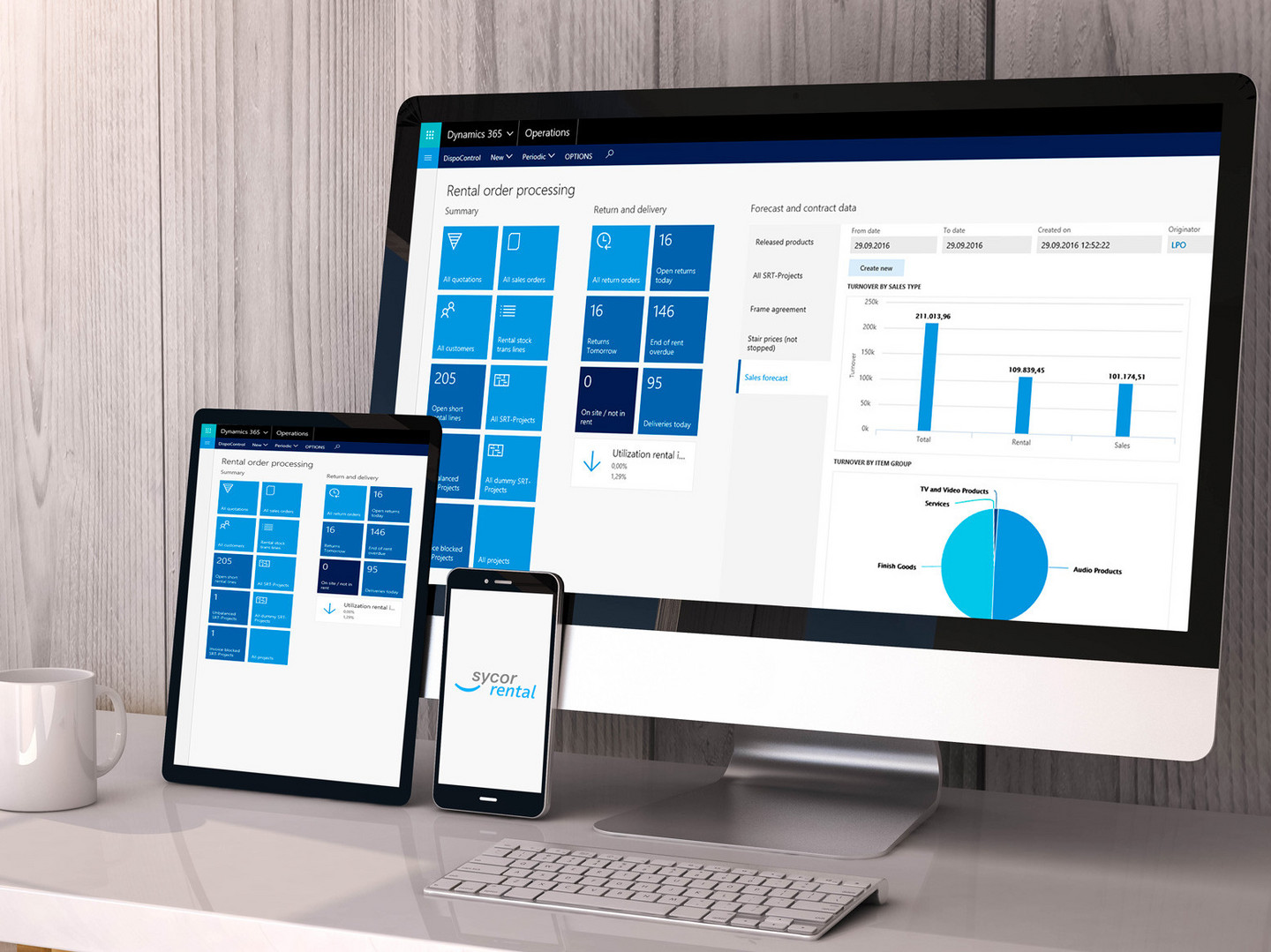
Sycor.Rental leading the way in equipment rental solutions.
Rental management in the Microsoft ecosystem has evolved from Dynamics AX deployments supported by custom development and partner solutions into cloud-based Microsoft Dynamics 365 environments that connect rental workflows with finance, supply chain, service, analytics and automation. The technology foundation has changed substantially, but the central requirement has not: equipment rental businesses still need specialized processes that standard ERP and financial lease accounting do not cover on their own.
To discuss how these capabilities apply to a specific rental operation, contact Sycor Americas online or call +1 877 487 9267.
What Is Dynamics 365 Rental Management?
Dynamics 365 rental management means managing rental-specific workflows using Microsoft Dynamics 365 together with native, configured or industry-specific capabilities. Depending on the solution, this can connect equipment availability, quotations, contracts, dispatch, returns, billing and maintenance with the wider financial and operational processes managed in Dynamics 365.
Operational equipment rental involves far more than recording ownership or lease payments. A complete rental management system may need to support:
- Equipment availability, reservations, quotations, orders and contracts
- Check-out, delivery, transportation, dispatch, return and inspection
- Short- and long-term billing, including meter- and usage-based charges
- Fleet service, maintenance, parts, inventory and procurement
- Equipment sales, asset lifecycle management and branch transfers
- Multi-branch financial reporting and operational performance analysis
These requirements explain why rental companies have historically used industry extensions and implementation expertise alongside Microsoft ERP. The ERP platform supplies the shared financial and supply chain foundation; rental-specific functionality translates that foundation into day-to-day rental operations.
A Timeline: From Dynamics AX to Modern Dynamics 365 Rental Management
| Stage | Technology foundation | Rental-management model |
| Dynamics AX era | Finance, inventory, procurement and supply chain | Configuration, custom development and industry partner solutions connected operational rental workflows to ERP. |
| Dynamics 365 era | Cloud-based Finance and Supply Chain Management | Connected data, Power Platform, analytics, automation and AI-ready processes support modern rental ERP. |
| December 9, 2025 - XAPT IP agreement | Microsoft acquired elements of XAPT rental-management IP | Microsoft announced new Dynamics 365 rental capabilities under development; scope and availability must be confirmed in current documentation. |
1. Dynamics AX Established the ERP Foundation
Before Dynamics 365, many equipment rental organizations used Microsoft Dynamics AX to manage core finance, inventory, procurement and supply chain processes. AX provided a strong enterprise foundation, but operational rental requirements varied by sector, fleet and business model. Companies therefore commonly relied on configuration, customizations or industry-specific partner solutions to manage the rental lifecycle and connect it with back-office processes.
This model helped organizations move away from isolated rental-counter applications, yet it could also create technical debt. Heavily customized environments were harder to update, integrations needed ongoing maintenance and data could remain fragmented when rental, service and finance processes were designed separately.
2. Dynamics 365 Moved Rental ERP to a Cloud-Based Platform
The transition to Microsoft Dynamics 365 ERP shifted the emphasis from an on-premises ERP deployment toward a continuously updated cloud platform. For rental businesses, this creates the opportunity to connect operational and financial data within a scalable environment rather than maintaining separate systems for each function.
Dynamics 365 Finance and Supply Chain Management can provide the foundation for financial management, procurement, warehousing, asset-related data, reporting and cross-company processes. Power Platform tools can extend workflows, apps and analytics, while Microsoft Copilot and other AI capabilities can support selected tasks when the required licensing, configuration, permissions and data quality are in place.
The important change is not simply that the software runs in the cloud. A modern cloud-based Dynamics 365 platform can provide connected data, regular platform updates and a more consistent foundation for workflow automation, analytics and AI-ready processes.
3. Microsoft Announced New Rental Capabilities Under Development
On December 9, 2025, XAPT announced an intellectual property agreement under which Microsoft acquired elements of XAPT’s rental-management technology. According to the announcement, Microsoft plans to use that technology to support new rental management capabilities being developed within Dynamics 365.
The distinction is important: Microsoft acquired rental-management intellectual property from XAPT; it did not acquire XAPT itself. The announcement describes capabilities Microsoft is building and should not be read as confirmation that every planned rental function is already generally available. XAPT also stated that it would continue supporting existing customers and advancing NAXT365 and Tire365.
For the market, the agreement confirms Microsoft’s continued attention to the specialized operational needs of rental organizations. It does not, by itself, determine the final scope, timing, licensing or suitability of future functionality for every rental company. Those details should be evaluated against current Microsoft product documentation and the requirements of each implementation.
Dynamics 365 Asset Leasing Is Not Equipment Rental Management
Microsoft Dynamics 365 Finance includes Asset Leasing, but Asset Leasing is not the same as an end-to-end equipment rental management system. Microsoft describes Asset Leasing as a capability for managing, tracking and automating financial transactions for leased assets, including accounting under IFRS 16 and ASC 842.
| Comparison area | Dynamics 365 Asset Leasing | Operational equipment rental management |
| Primary purpose | Accounting for leased assets | Managing equipment rented to customers |
| Typical processes | Recognition, journal entries, depreciation, impairment and termination | Availability, quotes, contracts, dispatch, usage billing, returns, inspections and maintenance |
| Compliance focus | IFRS 16 and ASC 842 | Rental operations, fleet control, customer service and equipment lifecycle |
That financial purpose differs from the operational work of renting equipment to customers. Asset Leasing helps organizations account for leases and generate relevant journal entries. Operational rental management coordinates availability, customer quotes and contracts, delivery, dispatch, usage billing, returns, inspections, maintenance and the next rental event.
A rental organization may need lease accounting, operational rental management or both. The correct architecture depends on whether the business is accounting for assets it leases, renting its fleet to customers, or managing both sides of that model.
Why Industry-Specific Rental Solutions Still Matter
Core ERP capabilities create consistency across finance and operations, but rental businesses still differ in contract structures, rate calculations, meter billing, fleet classes, service models, transportation requirements and branch processes. An industry solution can translate those requirements into repeatable workflows while retaining the broader ERP data model.
Future native capabilities may reduce the amount of customization required for some scenarios. However, software functionality is only one part of a successful rental ERP. Data migration, process design, integrations, permissions, training, reporting and change management remain implementation responsibilities. Specialized industry knowledge is particularly important when a company rents, sells and services equipment across multiple locations or legal entities.
Where Sycor.Rental Fits in the Microsoft Ecosystem
Sycor.Rental is a separate, established equipment rental ERP solution built on Microsoft Dynamics 365 Finance and Supply Chain Management. It did not originate from XAPT and was not part of Microsoft’s XAPT IP acquisition.
Sycor.Rental connects rental-specific processes with broader finance, sales, service, inventory, supply chain and reporting capabilities. It is designed for established and growing rental organizations that need more than a standalone reservation or inventory system, particularly when operations span branches, entities, service teams or additional revenue streams such as equipment and parts sales.
The solution also provides a foundation for AI capabilities in modern rental ERP. AI does not replace sound process design or human oversight. Reliable use cases depend on accurate data, appropriate permissions and clear governance, especially for high-impact financial, contractual and operational decisions.
At Sycor Americas, we work closely with finance, operations and service stakeholders to understand how rental processes actually function before configuring the platform. This close-knit, collaborative approach helps align Dynamics 365 with Sycor.Rental with real-world workflows rather than forcing the business into a generic ERP model.
What the Evolution Means for Rental Businesses
At Sycor Americas, we recommend viewing this evolution as an opportunity to reassess the entire system landscape, not as a reason to adopt technology based on a product announcement alone. A practical evaluation should determine:
- Which rental workflows are supported today and which depend on configuration or an industry solution
- Whether finance, inventory, service and rental teams can work from consistent data
- How updates, integrations and customizations will be governed over time
- Whether reporting supports utilization, availability, maintenance cost, revenue and profitability across branches
- What data quality, security and human-review controls are required for automation and AI
- Whether the implementation partner has relevant rental-process and Microsoft platform experience
A qualified Microsoft Dynamics 365 implementation partner can help distinguish standard platform functionality from configuration, extensions and future roadmap items before the business commits to a design.
A Connected Platform, Built Around Rental Operations
The evolution from Dynamics AX to Dynamics 365 has given rental businesses a more connected, scalable and update-ready ERP foundation. Microsoft’s acquisition of rental-management IP from XAPT signals further investment in this area, but confirmed current capabilities should remain separate from announced development plans.
Industry-specific solutions and implementation experience continue to matter because rental operations extend beyond core ERP and financial lease accounting. For organizations with complex fleets, service requirements, multiple entities and connected financial processes, Sycor.Rental provides an established Microsoft Dynamics 365-based approach to bringing those functions together.
To evaluate whether Sycor.Rental and Dynamics 365 Finance and Supply Chain Management fit your operational requirements, contact Sycor Americas online or call +1 877 487 9267.
Frequently Asked Questions (FAQs):
Dynamics 365 rental management is the use of Microsoft Dynamics 365 together with native, configured or industry-specific capabilities to manage rental workflows such as availability, contracts, dispatch, billing, returns and maintenance while connecting them with finance and supply chain processes.
Rental management has moved from AX-era deployments that often relied on customizations and partner extensions to cloud-based Dynamics 365 environments with connected data, regular platform updates, workflow automation, analytics, Power Platform integration and an improved foundation for AI-enabled processes.
Under an agreement announced December 9, 2025, Microsoft acquired elements of XAPT’s rental-management intellectual property to support new capabilities being developed within Dynamics 365. Microsoft did not acquire XAPT, and the announcement did not state that all planned functionality was already available.
No. Asset Leasing focuses on financial transactions and accounting for leased assets, including IFRS 16 and ASC 842 requirements. Equipment rental management covers operational processes such as availability, customer contracts, dispatch, usage billing, returns, inspections and maintenance.
Sycor.Rental is a separate industry-specific equipment rental ERP solution built on Microsoft Dynamics 365 Finance and Supply Chain Management. It connects rental workflows with enterprise finance, inventory, service, sales and reporting, and it is not derived from XAPT’s technology.
Contact Sycor Americas today to discuss our rental solution.
Arrange a free, no-obligation consultation with one of our experts at your convenience, by submitting the form to the right --------------->
Your Contact for Sycor.Rental Equipment Rental Software:

Our partners
All partners